

Article: Beach volleyball court: dimensions, rules and layout
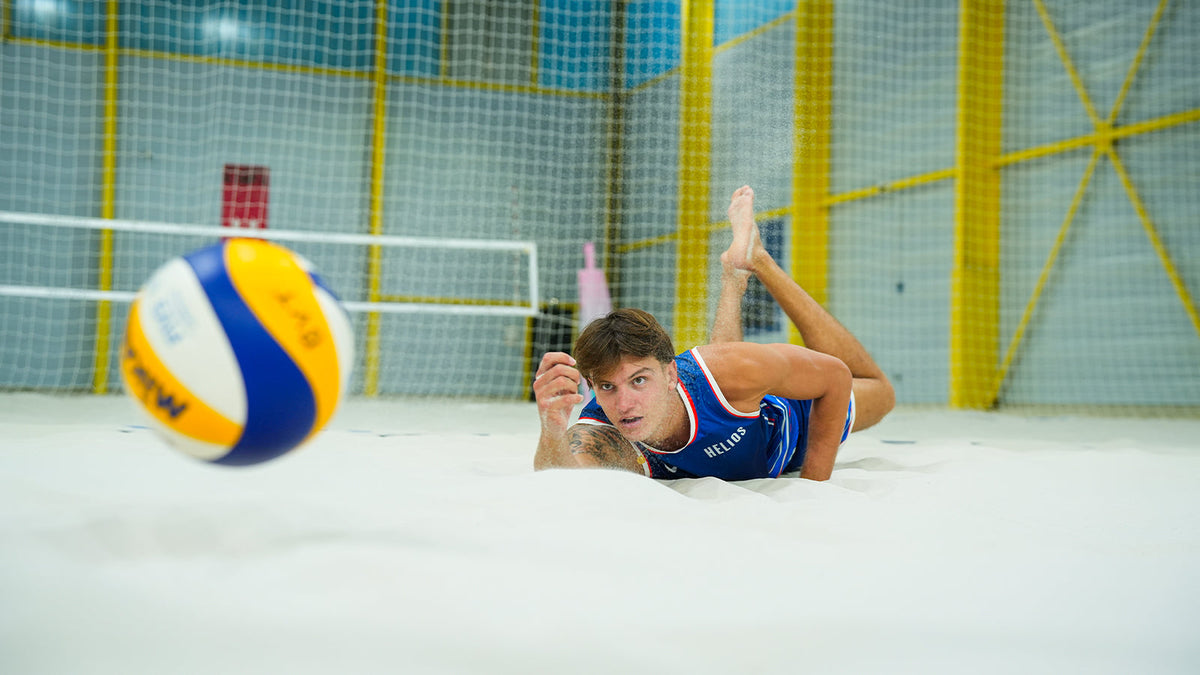
Beach volleyball court: dimensions, rules and layout
Beach volleyball court: dimensions, rules and layout
A beach volleyball court is not just sand with a net in the middle. It is a 16 m × 8 m playing area, with a 5 to 6 m free zone all around, at least 40 cm of sand and a net at 2.43 m. These figures determine ankle safety and the quality of play. Here they are, without approximation.
Official dimensions of a beach volleyball court
The playing area measures 16 m long by 8 m wide, or 128 m². The lines are part of the court: they are included in these 16 × 8 m.
Beach volleyball court dimensions are the same everywhere. From the local beach tournament to the Olympic Games. There is no standard reduced format.
Around the playing area, the free zone. 5 to 6 m behind the end lines, 5 to 6 m on the sides. This is the running space for high balls and diving saves. Without it, a beach volleyball court becomes a trap: posts, fences, trees, furniture.
With the free zone, reserve 26 to 28 m long and 18 to 20 m wide. About 500 m² on the ground. This is the surface area to plan before ordering the sand.
The net is measured at the center of the court: 2.43 m for men, 2.24 m for women. A maximum difference of two centimeters between the two sides.
|
Element |
Official dimension |
|---|---|
|
Playing area |
16 m × 8 m (128 m²) |
|
Free zone, sides |
5 to 6 m |
|
Free zone, ends |
5 to 6 m |
|
Recommended total surface |
26 to 28 m × 18 to 20 m |
|
Net height, men |
2.43 m |
|
Net height, women |
2.24 m |
|
Line width |
5 cm |
|
Sand depth |
40 cm minimum |
These values are those of the official FIVB rules.
The sand: the real constraint
Sand is the most expensive and most often failed part of a beach volleyball court.
Depth: 40 cm minimum. Below that, you are playing on disguised hard ground. For a club or a very busy site, aim for 40 to 50 cm: sand compacts, gets lost, moves.
Type of sand: washed, round grains, without silt or clay. Neither too coarse - it hurts and heats up - nor too fine - it flies away, sticks to the skin, raises dust. The sand must be sifted, without stones, without shells, without debris.
Drainage. A layer of gravel 15 to 20 cm thick, a geotextile, then the sand. Water must pass through the layer, not stagnate. A court that retains water turns into paste and hardens when it dries.
The surface decides everything. A dive received on packed sand is a sprained ankle. Sand that is too fine is a slide that ends badly. Setting up a beach volleyball court without treating the sand is building a court that injures. It is the leading cause of injuries on amateur facilities. The construction principles are detailed by USA Volleyball.
The net and the posts
A beach volleyball net is chosen based on three criteria: length, tension, fixings.
Net dimensions: 8.50 m long, 1 m high, 10 cm mesh, 7 to 10 cm top band.
Height: 2.43 m (men), 2.24 m (women), measured at the center of the playing area. Check at both ends: the net must remain horizontal.
Posts: placed 0.7 to 1 m outside the side lines. Round, without edges, securely anchored. Pad them: this is the area where you dive.
Tension. The net remains taut, the top right band. A sagging net distorts the game and tires the shoulders. Provide guy wires with tensioners to adjust without dismantling.
Antennas. Two rods of 1.80 m, 10 mm in diameter, fixed to the outer edge of the side bands, with 80 cm above the net. They delimit the passing space: the ball must cross the net between the two antennas. Without them, no clear reading of the game.
For a club or a campsite, anchoring matters more than height. Concrete bases or piles, vertical posts, tight guy wires. A post that moves is a court to redo.
The court lines
A band 5 cm wide, contrasting color with the sand. Never paint.
Sand moves. Paint fades in a few weeks, gets buried, blends with the ground. A band moves, is retightened, is replaced.
The lines are part of the court: a ball that touches the band is good. Hence the importance of the width. A thin rope does not give the same reading, neither to the players, nor to the referee.
Fixing: stakes at the corners, elastic tensioners, flat band. Check the tension after each session. A floating line creates disputes.
Essential rules to know
Beach volleyball rules can be summarized in a few lines. They change everything compared to the indoor game.
-
Two players per team. No substitute in official competition. The 4-player format exists for recreation, it is not the standard.
-
Three touches maximum per team.
-
The block counts as one touch. A team that blocks has only two touches left to return.
-
No pushing the ball with open fingers. The ball is hit or accompanied, never thrown.
-
The serve alternates from one team to the other. The same player serves as long as their team scores.
-
Sets to 21 points, two points difference. 15 points for the deciding set.
-
Change sides every 7 points, every 5 points in the deciding set.
-
No positions, no rotation. The two players place themselves freely. Only the serving order is fixed.
-
Specific ball: lighter and less inflated than indoors, 260 to 280 g, 66 to 68 cm circumference.
Setting up a beach volleyball court
Setting up a beach volleyball court for a club, a campsite, or a school starts with the ground, not the sand.
1. The court. Flat, stable, excavated. No slope: a ball that rolls out of the lines cannot be recovered.
2. Drainage. Gravel, geotextile, outlet. Without a network, water accumulates and the sand gets dirty.
3. Orientation. North-south, so as not to serve facing the sun. If the site imposes an east-west axis, provide a screen or adapted times.
4. The volume of sand. 16 × 8 m over 40 cm = 51 m³, about 80 tons, for the playing area alone. With the free zone treated over the entire surface, it rises to nearly 180 m³. Most courts only put it under the playing area.
5. Safety margins. No obstacles in the free zone: no lighting post, no fence at three meters, no concrete block.
6. Maintenance. Rake after each session. Remove stones, shells, pieces of glass. Top up by 2 to 5 cm per year. Water in the summer against dust and heat. Cover in winter if the site freezes.
A beach volleyball court is judged by its sand and its free zone. The rest is sorted out.
Playing on a beach volleyball court: what to plan
A beach volleyball court does not forgive improvisation. Two hours of play, full sun, sand at 50 °C.
To bring:
-
1.5 to 2 L of water per player for two hours.
-
Sunscreen 50, applied before and after the game.
-
Cap or visor, sunglasses that stay on.
-
Towel, sand socks if the sand burns.
-
An outfit that dries quickly and does not retain sand.
The outfit is part of the game. A jersey that sticks, shorts that weigh, unsuitable shoes: three good reasons to leave the match. For the details of cuts and materials, read our guides: women's beach volleyball outfit and men's beach volleyball outfit.
On the style side, the HELIOS collection is designed for sand: lightweight materials, clean cuts, colors that hold up in the sun.
FAQ
What are the dimensions of a beach volleyball court?
16 m long by 8 m wide for the playing area. Add a free zone of 5 to 6 m on the sides and behind the end lines. The total surface area to reserve is 26 to 28 m × 18 to 20 m.
What is the height of the beach volleyball net?
2.43 m for men and 2.24 m for women, measured at the center of the court. The difference between the two sides must not exceed 2 cm.
How many players in a beach volleyball team?
Two players, without a substitute in official competition. The 4 or 6 formats exist for recreation, but the reference format remains 2 against 2.
What sand depth for a beach volleyball court?
40 cm minimum according to FIVB rules. Count 40 to 50 cm for a club court, to absorb compaction and wear. The sand must be washed, sifted, without stones or shells.